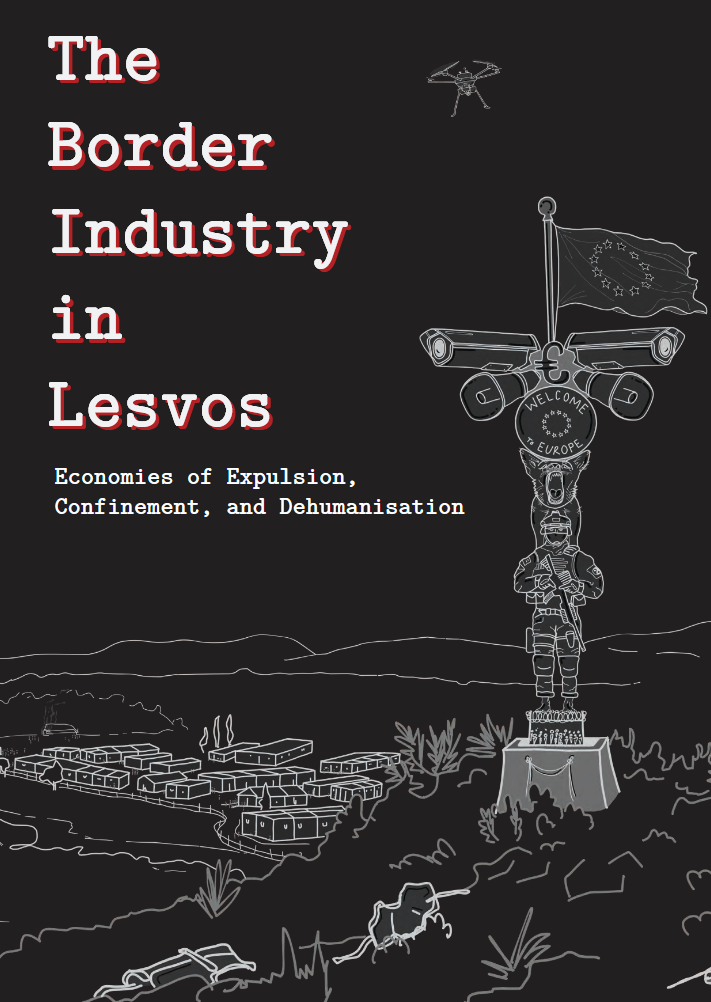
Based on four years of research and documentation, the report titled The Border Industry in Lesvos: Economies of Expulsion, Confinement, and Dehumanisation, analyses the role of Frontex, EASO (renamed EUAA), and Greek Ministries as procurers in 554 contracts with 289 contractors worth a total of €1.115 billion only in framework agreements.
The report raises many questions about the transparency of procurement procedures.
The research shows that despite Small- and Medium-sized Enterprises (SMEs) accounting for around 70% of contractors, over 80% of the total funds awarded go to Large Enterprises or consortia involving at least one Large Company.
Multinational corporations have a significant share of the awarded agreements and are complicit in violence around the world that leads to the displacement and forced migration of populations, including the Palestinian people, who are being subjected to genocide.
The EU’s techno-solutionist approach to border surveillance and control is also apparent, with large-scale investment in technologies such as drones, AI and biometric systems. The use of new technologies follows the EU’s and its member states’ increasing outsourcing of the provision of goods and services.
The report also contains four case studies:
1. Pushbacks: Greece’s EU-backed pushback policy, a systematic attack on migrants constituting crimes against humanity, relies on private provision of extensive surveillance technology, land vehicles, boats, life rafts, ropes, and cables, whose cost totals at least €370,835,791 in 2020-2022.
2. Camps: Camps on Lesvos proliferated during the period of our study (2020-2022), when ‘Closed Controlled Access Centres’ were codified. During this time, we identified 15 contractors involved in the construction, operation, and management of camps (Moria, Kara Tepe, Megala Therma, and Vastria) and 22 landowners who leased land for camps on Lesvos, to a total revenue of €123,609,455.
3. Catering: High-value contracts were awarded to provide meals in refugee camps around Greece, generating €56 million in revenue in Lesvos alone between 2020-2022, despite ongoing, documented shortcomings in food provision, a violation of human rights. These lucrative contracts resulted in local catering company, Elaitis Catering, becoming one of the largest economic actors on Lesvos island, now managed through its parent companies by Luxembourg-based private equity firm CVC Capital Partners. This shows how the border industry has become one conduit for the massive transfer of public funding to private equity.
4. Surveillance: ‘Closed Control Access Centres’ in Lesvos use Hyperion and Centaur surveillance systems, which operate biometric identification, app-based communications, and algorithmic behavioural analysis of CCTV, breaching privacy rights in violation of GDPR. Investigation of the tenders process reveals how the Hellenic Ministry of Migration and Asylum, the contracting authority, failed to include provisions that would require the companies ESA, ADAPT IT, and Space Hellas to follow basic obligations under the GDPR, illustrating how these contracting arrangements reproduce the ability for states to resist compliance with laws that protect citizens and migrants from rights violations.
The border industry database currently comprises 1139 contracts with 600 contractors, which were signed between January 1, 2020 and December 31, 2022 and includes contracts performed in Lesvos, the Aegean, Greece, and the EU. The database is a work-in-progress with expanding temporal and geographic scope. The aim of the border industry project is to make visible who profits from border regime; the money flows and supply chains that trace corporate complicity; and levels of integration and dependency of local economies on border infrastructure—camps, detention centres, and militarised border zones. The border industry database is publicly accessible and intended to support research, documentation, and litigation efforts to bring accountability from states corporations and other private entities that are complicit in border violence.